
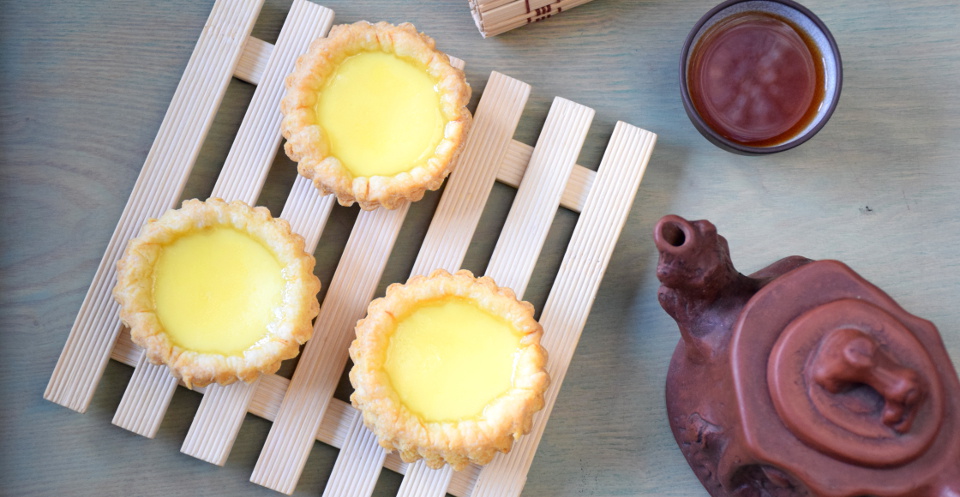
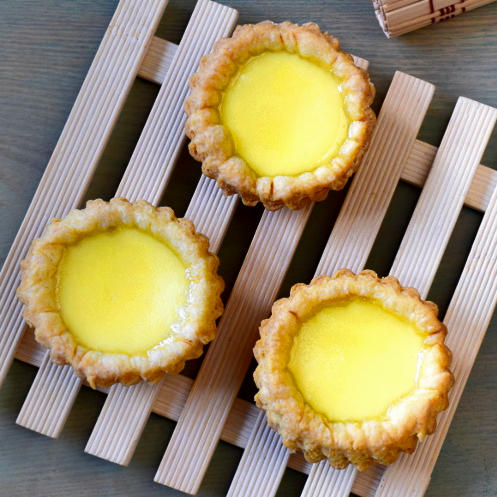
If you like Cantonese dim sum, you must be familiar with Hong Kong egg tarts. While the barbecue meat bun is the signature item of dim sum restaurants and Chinese bakeries, the most lovable dessert will be none other than the Hong Kong egg tart. Hong Kong egg tarts are derived from the Portuguese pastel de nata from when the Portuguese arrived in Macau at the turn of the twentieth century.
Since Macau is just a short boat ride from Hong Kong, the locals modified the original Portuguese egg tarts and served them with other Cantonese dim sums for breakfast. As a result, the Hong Kong and Macau egg tarts differ slightly. Macau’s egg custard tart resembles the Portuguese tarts with a scorched caramelized exterior. On the other hand, the British custard tart influences the Hong Kong egg tarts with a custard feeling with a glossy smooth finish.
Note: This post may contain affiliate links. Please read my privacy policy for more info. I may receive commissions for purchases made through links in this post. As an Amazon Associate, I earn from qualifying purchases.
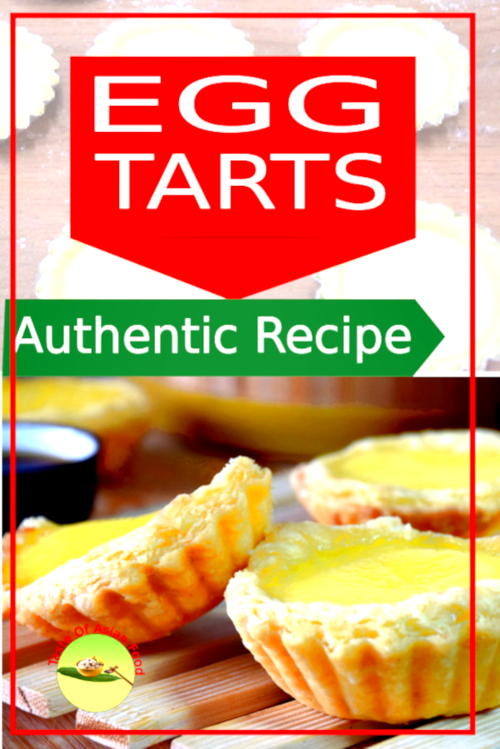
1. Hong Kong Egg Tarts (蛋挞)
a. Two types of pastry to make egg tarts
There are two types of Hong Kong egg tarts. One is with shortcrust pastry, and the other uses Chinese puff pastry. The best Hong Kong egg tarts are made from Chinese puff pastry, slightly different from Western puff pastry. This pastry is less oily than the Western version, with a more floury flavor. Traditional pastry chefs used lard to make this pastry, but recently, many bakeries and dim sum makers have changed from lard to butter, which is healthier and has a universal flavor.
b. What is Chinese puff pastry?
“The flavor of the Chinese puff pastry (酥皮) is different from the western version. The most significant difference is that the Chinese version is less oily. It is the pastry for many Chinese dim sums, such as egg tarts, salted egg rolls, and baked buns (烧包). It is a delectable surprise for people who have not tried it.”
c. The difference between Chinese and Western puff pastry
Chinese puff pastry is very similar to Western puff pastry as they are flaky and will form a flaky tart crust. However, the Chinese puff pastry’s oil (butter, lard, or shortening) is mixed with flour before being wrapped in the water dough. Therefore, the texture and taste are different from the western puff pastry.
2. The texture and flavor of Chinese puff pastry is the best for egg tarts
The flavor of Hong Kong egg tarts fresh from the oven is amazing. Having them out of the oven is a new experience against the lukewarm version you get from the store. Egg tart made with Chinese puff pastry is one of the best Chinese desserts among the dim sum spread in Cantonese cuisine. Many people wish to make it at home but, finally, give up because of the tedious process and required skills. Some people settle for the second-best (shortcrust pastry), which is easier to make.
However, the essence of the egg tarts lies in the unreplaceable texture and flavor of the Chinese puff pastry. Therefore, you need to use the Chinese puff pastry for this recipe to make the REAL and AUTHENTIC Hong Kong-style egg tarts comparable to the best dim sum stores in Hong Kong and Southern China.
Making puff pastry is tedious, but enjoying the fruits of your labor is gratifying. I simplified the recipe without compromising the quality. Now is your turn to bake and enjoy eating this famous Hong Kong dim sum as much as I do.
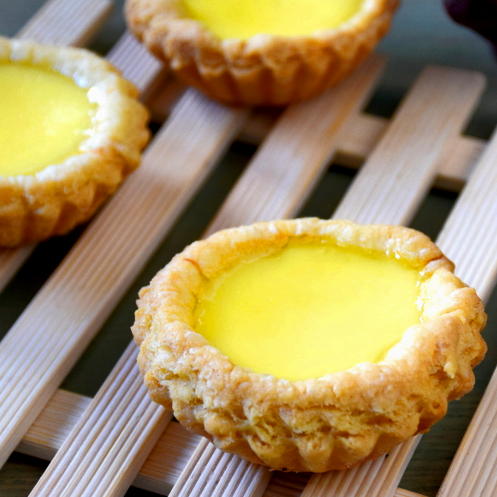
3. Six essential tips to make the best Chinese egg tarts
Take a moment to read through these tips before attempting the recipe. (If you are new to egg tarts.)
- When you mold the pastry pieces into the tart molds, press the pastry towards the sides and bottom of the mold. Pierce a few holes in the bottom with a fork to prevent the bottom of the pastry from rising. Do not squeeze the pastry, as it can damage the delicate layer of the pastry.
- Use a larger cookie cutter to cut the pastry to have ample pastry to fit into the mold. Next, use a round knife or the side of a fork to trim off the extra pastry. The upper side of the pastry will be evenly trimmed, and the perforated layer will be visible after baking. Keep the tart base in the fridge before filling in the egg liquid. It helps to keep the butter from melting, and the oven’s rapid temperature increase creates distinct pastry layers.
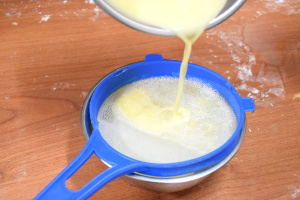
- When you prepare the egg filling, cool the syrup, then pour it into the egg. The hot syrup will partially cook the egg and form small, unsightly lumps. Filter the egg mixture twice through a fine mesh strainer to obtain a clean, smooth egg liquid before pouring it into the tart base. Filtering the egg mixture will also remove all bubbles from whisking the eggs. It is essential to ensure no air bubbles are visible on the surface to achieve a smooth custard surface.
- Once the tart bases are filled with egg filling, bake immediately in a preheated oven at 200 degrees C/390 degrees F for 15 minutes, followed by 180 degrees C / 356 degrees F for another 10 minutes. The initial high oven temperature will cause the pastry to rise rapidly and form a multi-layer structure, while the lower heat will finish the cooking subsequently. Leave the oven door ajar for five minutes, then remove the egg tarts to let them cool down slowly.
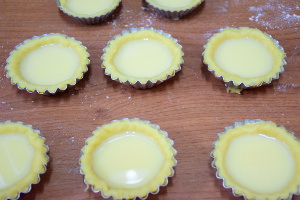
- Fill the tart shells up to 70%. However, do not overfill; the tart filling will expand and spill over when baking.
- Once the egg tarts cool down, the sugar syrup will form a shiny layer on the surface of the custard. Do not reduce the sugar quantity in the ingredients of the filling if you want to get a shiny surface.
4. Five tips for rolling and folding pastry (Note: This is important!)
The most challenging part of making the puff pastry is rolling the dough. Many people encounter tearing the water dough, which causes the oil layer in the middle to ooze out to the surface. The dough becomes oily, sticky, messy, and unmanageable. When you are troubled with the oil leaking from the dough, most people will reach out to the flour container with both hands full of sticky oil mixture. The butter is getting softer while you frantically patch up the leaking dough with flour. So, more flour is required, and eventually, the dough will turn into a lump of sticky mass. This section is written specially to minimize this problem.
a. Don’t be greedy.
The pastry is flakier if you use more oil dough. However, the water dough can only hold a certain volume of oil dough without tearing. You can reduce the volume of oil dough in the recipe if you prefer a more easy-to-handle recipe. It will be close to the original formula, albeit less flaky.
b. Use the second cling film to fold the dough
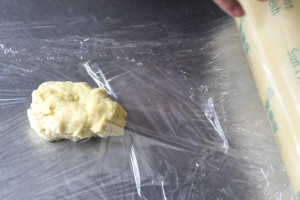
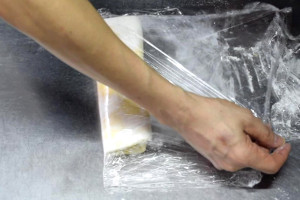
The cleanest way to roll and fold the dough is to use two cling films, one at the bottom and another on top. It is far better than just sprinkling flour to prevent the pastry from sticking to the surface.
Place a large piece of cling film on the surface of the chiller top or a stainless steel table. Sprinkle flour on the cling film liberally. Next, put the water dough on the cling film. Finally, cover the water dough with another cling film. The second piece of the cling film prevents the dough from sticking to the rolling pin when you roll out the dough.
c. Place the oil dough on one side of the water dough.
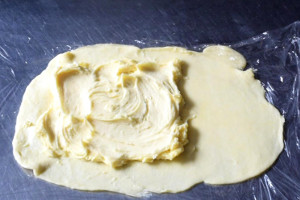
The oil dough will stick to any surface. Therefore, I like to directly remove it from the electric mixer onto the water dough. You can use two stainless steel spoons to transfer it quickly. Some remain in the mixer bowl, no matter how thoroughly you scoop it. It is not worth spending the time to remove (and potentially messy) any small amount from there, as there will be no significant impact on the final result.
The cling film prevents the dough from sticking to the rolling pin. How to find the optimum softness of the dough before rolling it out. Chill it until it is slightly firmer than I want. After placing the dough on the table, I will put my palms on top (with a cling film protected) to let my body heat to soften it. The softness is just right when I can use my palms to stretch the dough a little thinner by lightly pressing on it.
d. Roll gently.
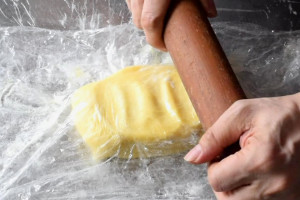
Always roll the pastry gently with short strokes. Long strokes can break the layers of the pie dough.
Use the cling wrap to fold the dough.
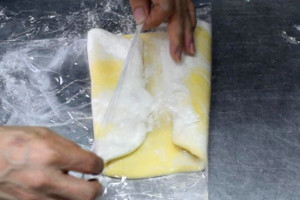
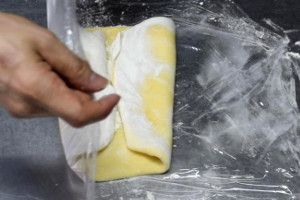
Fold the dough like closing a book when the dough is thin enough.
Remove the top layer of the cling wrap. Hold the corners of the cling wrap to fold the dough toward the center. This method is clean and tidy, as your hands are not touching the dough.
Repeat the rolling and folding steps three times.
e. Be patient.
It would help if you resisted the temptation to roll out the pastry when it was too soft. Instead, chill the dough again (the freezer is faster) until it is firm enough for the next fold.
It may take at least twenty minutes for a small dough but much longer for the bigger one. The time required depends on the temperature of the chiller or freezer.
You can leave the dough in the refrigerator overnight to continue the next day.
5. More tips to ensure you make the best egg tarts ever
I know this is a LONG recipe post, but read through it before you start. 🙂
- Keep the butter cold at all times. The most frustrating thing when making puff pastry is when the butter begins to melt and leak through the layers of the dough. The layers of the pastry will be poorly defined, and the butter will stick to the rolling pins and the table.
- The common solution is to quickly cover the broken area of the pastry with plenty of flour, hoping that the flour will absorb the butter and prevent further leakage. Unfortunately, this does not always work because the longer you delay, the more butter will melt and become messier. The best way is to place the pastry quickly in the freezer to let the butter harden before resuming the folding and rolling process.
- Use an electric food processor to blend the dough. It saves you time.
- Rest the pastry before molding. I usually do not stretch the pastry further during molding. Instead, I usually cut a piece of pastry big enough to cover the entire inner surface of the tart pan with some extra for trimming. Since puff pastry will shrink after rolling, it is best to rest it for a few minutes, then trim the excess. This will ensure the perfect shape of the tarts.
- The optimum thickness of the pastry is 3 mm. The layers can break if you roll them too thin. On the contrary, too little egg liquid can be poured in if the pastry is too thick.
- Use butter, not margarine or shortening. Traditional Hong Kong egg tarts are made with lard, but the trend has shifted towards butter. I use butter in this recipe because this is the flavor I like. Shortening and margarine are easier to handle than butter at room temperature but do not taste as good as butter.
- There is no need to add vanilla extract to the recipe. Authentic Chinese egg tart does not contain vanilla.
- Add one percent salt to the recipe if you use unsalted butter for the pastry. For example, if the recipe calls for 100 g of butter, then 1g of salt should be added.
- Make a large batch. You can keep Chinese puff pastry in the freezer for a few months if you have cut the pastry, separate pieces with a piece of plastic wrap to prevent them from sticking together.
Update May 2023
I conducted a thorough review of this post and have made certain amendments to the recipe and included some additional information below :
- Since the pastry needs higher heat than the egg filling in the oven, the lowest rack is the best position to bake the egg tarts. This position will prevent the egg filling from being heated too quickly while the pastry is still underbaked.
- The baking duration is about twenty minutes. The egg filling will tend to swell and form a dome. If that happens, reduce the upper temperature by ten degrees Celsius and keep the oven door ajar for a few seconds to reduce the temperature. The egg custard will collapse after cooling if the filling is puffed up too high in the oven.
- Roll out the water dough large enough. The volume of the oil dough is big, so please roll the water dough thinly. Otherwise, you can run into a situation where the roll-out water dough is too small to wrap up the oil dough.
- Keep the work tidy using a metal spoon and silicone spatula to transfer the oil dough.
- The best way to trim the excess pastry. Roll out the pastry bigger than you think. Place it in the tart mold and ensure it is big enough to have excess from the edge. Trim off the excess pastry by pressing the side of the tart mold with the dough cutter or any flat object. The pattern of the pie crust will look neat. You can use muffin mold to make the egg tarts, although the shape will not turn out as those in dim sum restaurants.
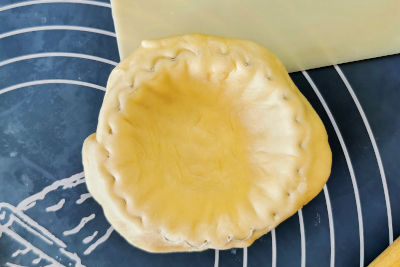
- Roll the pastry on a non-slip silicone pastry mat. I used to roll out the pastry on a cling film to prevent the pastry from sticking to the work surface. The pastry mat is better; I need only a small amount of flour to prevent the pastry from sticking.
- Do not overbake the egg tart. The surface will not be smooth once it is overbaked. The custard is cooked if you pierce a toothpick on it and can stand on itself.
- Can I reuse the pastry? Yes. Stack up the leftover of the leftover pastry and roll it out again. The quality is almost the same as the fresh one.
- Can I blind-bake the pastry shell? It does not work for me. The pastry puffs up too much unless you add some beads in the tart shells. You don’t need to blind-bake it and still get a good result.
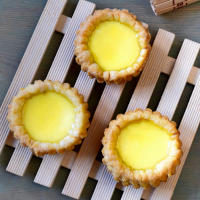
Egg Tart Recipe With Chinese Puff Pastry
Chinese egg tarts ( 蛋挞 ) is one of the most popular Chinese dim sum. Try this traditional egg tart recipe.
Ingredients
Oil dough
Water dough
- 250 g plain flour
- 1 eggs
- 1/2 teaspoon of salt
- 100 g of ice water
Filling:
- 5 eggs
- 80 ml milk
- 165 ml of water
- 80 g caster sugar
- Egg tart molds
Instructions
Water dough
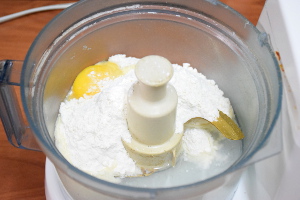
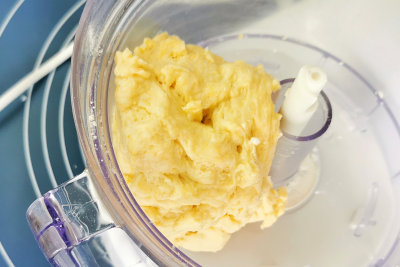
- Put the plain flour, egg, and ice water in the electric food processor.
- Mix them until they combine and form a ball.
Oil dough
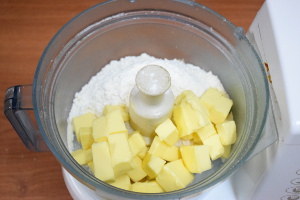
- Cut the chilled butter into small pieces.
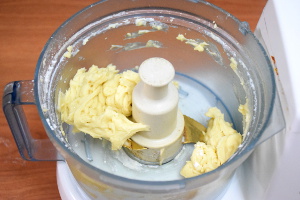
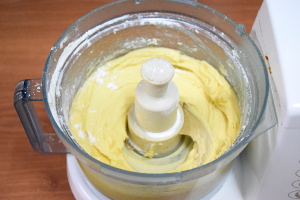
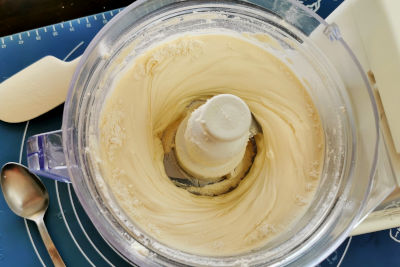
- Put the butter and flour in an electric food processor. Use the pulse function to mix them until it forms bridges and strands.
Prepare the pastry
- Spread a large piece of cling film on the tabletop, sprinkle with some plain flour.
- Flatten the water dough and place another piece of cling film on top.
- Roll the water dough to form a large square.
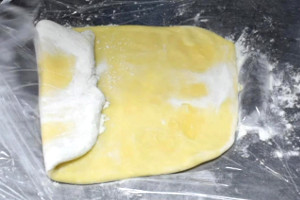
- Remove the cling film on top of the water dough, place the oil dough in the center and fold the sides of the water dough over the oil dough. Make sure the oil dough is fully covered by the water dough. Flatten it with a rolling pin. (Analogy: Now the dough looks like a sandwich, with the oil dough mirrors the filling of the sandwich, and the water dough mirrors the bread.)
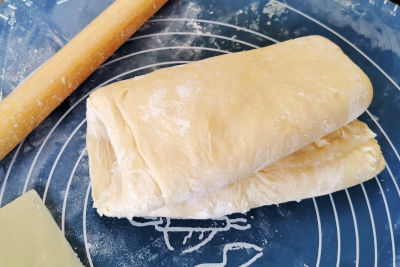
- Wrap it in cling film and leave it in the chiller for twenty minutes or until it hardens.
- Remove it from the chiller Flatten it with a rolling pin to about 3cm thick. Fold both ends of the dough toward the center like closing a book. (Analogy: Now it resembles a multilayered sandwich.) Place it into the chiller again for 20 minutes.
- Repeat the folding process (step 6) three more times.
- After the last repetition, flatten the dough to about 3mm thickness. Use a cookie cutter or bowl to cut out pieces of round pastry that are slightly larger than the area of the mold.
- Put the cut pastry into a mold. Lightly press the pastry onto the surface of the mold.
- Trim the sides with a fork or a blunt knife.
Filling
- Melt the sugar with water to make a simple syrup. Let it cool.
- Beat the eggs for a minute.
- Add the milk and syrup to the egg. Mixed well.
- Filter the milk liquid twice to remove impurities.
- Fill each empty pastry shell up to 70%.
Baking
- Bake it at 200 degrees C/ 390 degrees F for 15 minutes, then reduce to 180 degrees C / 356 degrees F for another 10 minutes. Leave the oven door ajar for five minutes then remove the egg tarts.
Recommended Products
As an Amazon Associate and member of other affiliate programs, I earn from qualifying purchases.
Nutrition Information:
Yield: 12 Serving Size: 1Amount Per Serving: Calories: 406Total Fat: 24gSaturated Fat: 14gTrans Fat: 1gUnsaturated Fat: 8gCholesterol: 159mgSodium: 302mgCarbohydrates: 39gFiber: 1gSugar: 8gProtein: 8g
This data was provided and calculated by Nutritionix on 1/19/2019
More recipes for you
If you like this recipe, I want to suggest other popular Asian recipes for you to try. Here are my picks:
Hot and sour soup. One of the most popular Chinese soups outside Asia, hot and sour soup can be prepared easily by following this step-by-step guide.
Sweet and sour fish. This fish dish is a popular street food in Malaysia. Subsequently, the Chinese restaurants make a few twists and transform it into a restaurant-style presentation with proper garnishing.
Chawanmushi is a delicate and savory Japanese appetizer. Now you can make it at home by following this recipe.
Hi KP,
I’M sorry to bother you again. But do I skip to step 6 or I go to step 5.
And do you know of a way that we can make this without a food processor.
Thank you,
Francid
Hi Francid,
You can mix the oil dough with a metal spoon if you opt not to use an electric food processor. It does not need to be well mixed. For the water dough, you can knead it by hand just like making bread.
I’m very confused as to how to make the oil dough. If it is wet and oily how do I roll It into a ball. (Much less knead it.) I can’t watch the video as I am in china and youtube is blocked
Dear Francid,
I get your questions, and I am trying to explain as clear as possible. I can understand how difficult it is to visualize how to do it without the access to my YouTube video in China. Nevertheless, here is my answer.
The oil dough is sticky. After you mix it in the electric mixer, use a metal spoon to remove it from the mixer bowl, and place it straight on top of the water dough. The instruction in the recipe is confusing because I mention ‘knead’ which is incorrect. It is like scooping out soft ice cream. I normally use two metal spoons to do it. One spoon to scoop the oil dough, and the other one to remove the oil dough on the first spoon. You will not be able to remove all from the mixer bowl as it is sticky. It is OK.
Thanks for letting me know the confusion, and I have made the necessary correction in the recipe.
Best regards,
KP Kwan
Dear KP,
I forgot to tell you that I blind bake first my tart shells before adding the egg custard. I blind baked the shells until already crisp enough. After that I continue baked with the egg custard.
I had already tried not blind bake first the tart shells, but the pastry was always not crisp enough(still raw) meanwhile the egg filling already puff up so high. So i decided to blind baked first the shells.
My egg filling recipe :
2 egg yolks
150 ml milk
40 grams sugar
1/2 teaspoon vanilla extract
Thanks for your advice!
Dear Ferris,
I follow your recipes and replicate it, and this is the result. (see image)
After looking at your recipe, I find that there is a difference from mine.
In my recipe, the amount of egg (5 eggs or 245g) is roughly equal to the liquid (80ml milk + 165 ml water= 245ml).
In your recipe, the amount of egg (2 egg yolk is about 32g) is not equal to the amount of liquid (150ml milk). By calculation, it is one part egg and 4 1/2 part liquid.
The liquid may be too much, and the eggs are not able to hold the custard together and cause the breakage, crack, and shrinkage. Try to reduce the milk or increase the egg to see if it works.
Hope this helps.
KP Kwan
Hi KP.
Great recipe and tutorial!
I wanna ask why my eggtart filling always cracked after several hours of baking. The hole of the cracked is always getting bigger and bigger as time goes by. Why this is happen? And how do I solve this problem?
Many thanks!
Hi Ferris,
There is a common reason- overcooking and overheating. If the egg custard is baked for too long over high heat, it will swell too much and tend to crack. Try to shorten the time of baking or reduce the temperature a little.
Hi KP.
Thanks for your advice. I have tried before to reduce the temperature to around 150 C ~ 175 C. I noticed that it took very long time to the custard to set. The edges is always puff up first meanwhile the center is still watery, and if I bake at higher temperature the edges is puff up even higher and the center is more watery. I tried to open the oven door if this happen so the edges is not puff up too much, and wait to the center until slightly woobly. But the result is always the same. It cracked and even cracked more when completely cooled after several hours. And also it always shrinked down at the center.
What can I do to solve this? I want the look of my egg tart beautiful like yours even had been stored for hours.
Thank you so much !
Really look forward for your advice.
Dear Ferris,
It seems the problem is not due to overheating or high temperature. In fact, the temperature of 150 to 175 degree Celcius seems too low to enable the pastry to fluff up completely.
Is the problem happened by using the custard formula of my recipe or another one? If it is from other recipes, maybe you can let me know, and I’ll try to help out.
Would it be possible to make one large egg tart instead of several smaller ones? I assume the baking times would be different.
Never attempt to make sumo size egg tarts. I think there will be two small differences:
1. As you said, longer baking time.
2. Since the larger one will hold more egg liquid, the base of the tart crust may compress too much by the weight of the egg liquid. It may not be fluffy as expected. It is possible to bake the empty pastry without the egg until it is nearly cooked, then fill the egg liquid and continue baking.
As I mention I never try this way so if you ever make the Big Mac size egg tarts, please let me know 🙂 .