
The biggest challenge of making whole wheat bread is to get the soft, and fluffy texture with good volume.
In this article, I want to share with you how do we make our whole wheat loaf in our cafe, by using the TangZhong method similar for the Japanese milk buns, one the most fluffy and souffle-like texture oriental buns.
We went through a series of experiments and ongoing modification, which finally settled with the stable method which we are using today.
Since most of the Asian preferred soft buns over hard rolls but yet prefer a healthy diet, whole wheat, and multigrain loaves are now available in most of the Asian bakeries. However, since Asian prefer soft buns, most of the whole wheat bread in Asia do not include more than fifty percent of whole wheat flour.
This recipe consists of 33% of whole wheat flour with the addition of the starter called TangZhong 湯種.

Note: If you have never made bread before, please read this article which covers all the aspects of basic bread making.
How to make whole wheat bread that is soft and moist
The following sections explain how do we prepare our oriental version of the whole wheat loaf by using the starter called tangzhong.
1. Prepare the tangzhong
Tangzhong is the secret weapon in this recipe that makes the bread soft, tender and has a close crumb texture. This is the same method to make buns in China and the Hokkaido Milk Buns.
Here are the steps:
- Measure 25g of white flour in a small pot.
- Add 125ml of cold water and stir constantly to avoid forming lumps.
- Place over low heat and slowly heat it up until 65°C/150°F. If you do not have a kitchen thermometer, heat it up until the starch turns semi-translucent and thicken.
- Remove from heat. Let it cools before adding to the dough.
What is Tangzhong
According to Harold McGee’s book On Food and Cooking, Tangzhong mainly consists of gelatinized starch.
During baking, the starch granules absorb water, swell and form a rigid structure surround the carbon dioxide. As the expansion of the bubbles stops, the water inside the bubbles will evaporate, creating a network of connecting holes.
In the case of Tangzhong, the starch is already gelatinized (The Conversion of solid starch into a starch-water gel) during cooking with water before adding to the dough. They do not need to be hydrated again. This plump starch granules perforated the gluten network and contributed to the spongy, light and close crumb structure.
2. Scale the yeast, sugar, and flour
Here are the steps:
- Scale the water required into the mixing bowl.
- Add the active dry yeast into the water.
- Add the brown sugar.
- Combine all the ingredients with a spatula to make sure the yeast is fully hydrated.
- Leave aside for five minutes.
- Add the white flour and whole wheat flour to the yeast mixture.
- Combine the flour and the yeast mixture with a wooden spatula.
Use more water for whole wheat flour loaf
If you substitute any amount of white flour with whole wheat flour of any bread recipe without adjustment, the bread will likely turn out dry,
Why?
White flour is made up almost entirely of the endosperm of the wheat kernel. It consists mainly of starch and proteins. Therefore they do not require additional water to keep it hydrated.
However, whole wheat flour is not a refined grain, which contains germ, bran and the endosperm. Brans and germs soak up water, which will make the loaf hard and dry. That is why we need to use more water to ensure the whole wheat loaf is tender and soft.
I use 63ml of water for every 100g of white flour to make my regular bread. I have increased the water amount to 70ml of water for 100g flour in this recipe to get the loaf that is soft and moist.
3. Autolyse for two hours
Autolyse refers to the resting process after combining the flour with water. So what you need is to mix the water and flour gently (no kneading) and let it rest for two hours. After that, add the remaining ingredients (yeast, salt sugar, butter) before proceeding to knead the dough.
During this resting process, the enzyme of the flour will break down the starch. At the same time, the proteins called gliadin and glutenin in the flour will start to hydrate and untangled into shorter pieces, developing strands of gluten ready for kneading and folding in the following step.
Autolyze is the crucial step to develop gluten which gives the whole wheat bread the much-needed strength. You may skip this process for dough that is made only with white flour. However, the gluten is much harder to form with whole wheat flour without autolyze first to untangle the protein pieces.
4. Kneading (with a food processor!)
The kneading process we use is different from many other recipes
Knead the dough will help to form gluten, but excessive kneading of whole wheat flour dough is counter-effective as the bran inside the flour can cut through and destroy the gluten. Hence, it has to be a controlled kneading, and the autolyze process is advantageous to develop the gluten first, which means we can shorten the kneading process and avoid the problem of over-kneading.
Our preferred way to ‘knead’ the dough is to use the food processor, not the mixer + dough hook.
This method seems a bit of unconventional, but the same approach has been discussed and tested by seriouseats.com. The result is astonishingly fast and successful.
Here are the steps:
- Add the autolyzed dough into the food processor.
- Add the salt and butter.
- Process the dough for slightly over one minutes, with occasional ‘pulse’. It is able to achieve the amount of gluten which enables to form the typical ‘windowpane’ while stretching the dough.
Cold butter is added at this stage, instead of adding the melted butter to the yeast mixture earlier on. According to one explanation that I have read, cold butter will presence between the gluten strands and make the loaf lighter. As for melted butter, it will absorb into the flour which makes the loaf heavy.
Fats and oils if added earlier, will bond to the hydrophobic amino acids along the protein chains and preventing them from bonding to each other, which will hinder gluten formation.
Another advantage of using the food processor is that this wet dough is very sticky and make it difficult to knead by hand. So why not let the machine to do all the hard work?
How the food processor helps to form gluten
I believe this is because the blade of the food processor is sharp and the spin action is fast. As long as it does not cut the dough and able to drag the dough in a circular motion, it will act as a quick kneading process.
The only downside is if we are making a much larger batch, we have to process the dough in batches with the small food processor. Therefore, we decided to use the conventional mixer attached with the dough hook to knead the dough for the large batch. It needs about ten minutes to achieve the desired elasticity.
However, the result by using a food processor for the small batch is better.
Note that I am using 30% whole wheat flour and 70% white flour in this recipe. If you increase the ratio of whole wheat flour to 50% or more, you will not expect to get the elasticity that can stretch the dough to paper thin. In that case, the endpoint is when you find that there is no further improvement of the elasticity even with more kneading.
5. Bulk fermentation (first rise)
Remove the dough from the food processor and keep it in a large bowl and cover with damp cloth or cling wrap. Let it ferment at room temperature until it doubles its size. It will take 45 minutes to one hour, depends on the strength of the yeast and the temperature.
The flavor will further develop during the fermentation process. It is ready when it doubles in size. If you poke deep into the dough with your floured finger, a dent will remain.
6. Pre-shape the whole wheat flour loaf
- Press the dough gently to remove the gas. Do it gently as not to damage the gluten strands.
- Remove the dough onto a floured working table.
- Divide the dough to the desired amount for each loaf. Flattened each portion to form a circle, either by your hand or a rolling pin.
- Fold the four corners towards the center, resemble making an envelope.
- Turn the dough over with the stretched side up. Hold the dough with your palm and rubs against the countertop in a circular motion. This rounding process helps to stretch the surface further and strengthen the gluten.
- Let it rest for another fifteen minutes before doing the final shaping.
7. Final shaping and proofing (second rise)
- Press to remove the gas in the dough.
- Roll out the dough and then shape into loaves or buns.
- Cover the dough with a damp cloth.
- Let it rise at room temperature until it doubles its size.
8. Baking
- Preheat the oven until it reaches 175°C/350°F.
- Brush the loaf with egg wash or water before baking.
- Bake the bread for thirty-five minutes or until the top turns golden brown. The actual baking time depends on the size of the loaf.
- Remove the loaf from the oven and let it cools for twenty minutes before cutting. Cooling is crucial as it allows the moisture in the bread to escape and make it easier to slice.

Three most essential points to deliver a soft, moist wholemeal bread with good volume.
1. Use more water.
Not adding extra water is the primary reason why the whole wheat bread turns out hard and dry.
The baker’s percentage should be at least seventy percent or more. It is possible to use a 1:0.75 ratio of water to flour if you use whole wheat flour alone.
2. Use the starter Tangzhong as the softener of the bread
As we explained earlier, tangzhong is the gelatinized starch that helps to produce the fluffy and souffle-like texture of the Japanese milk bread. It helps to make the whole wheat loaf soft the tender.
3. Autolyze before kneading the bread dough
In general, whole wheat bread does not rise as much as bread makes with white flour only.
The lack of volume is because development of gluten is harder with whole wheat flour as it consists of bran and germ. Bran and germ soak up water, and hence make the dough dryer.
Also, it is our natural reaction to knead the dough longer if we do not feel the gluten development is sufficient, which will tend to over-knead the dough. What happens is that the flakes of bran are acting as tiny blades slice through the gluten strands which will damage the structure of the dough and make it difficult to rise.
Therefore, autolyze is essential to make it easier to form gluten strands during kneading.
4. Proofing problem for bread with whole wheat flour
Finally, Since the whole wheat bread contains brans and germs that is heavy, it takes more time for it to gain volume. However, there is a limit to this. When it reaches the maximum volume that the structure can support, the loaf will collapse if the dough is over-proofed.
The whole wheat bread recipe
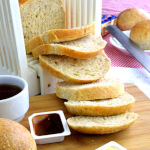
Whole wheat bread - How to make with tangzhong method
The biggest challenge of making whole wheat bread is to get the soft, and fluffy texture with good volume.
I want to share with you how do we make our whole wheat loaf in our cafe, by using the TangZhong method similar to the Japanese milk buns.
This method may not be the textbook way, but I hope you will find it interesting! Best of all, it works very well.
Ingredients
Tangzhong:
- 25g high gluten flour
- 125ml water
Main dough:
- 250ml water
- 350g high gluten flour
- 160g whole wheat flour
- 5g salt
- 30g brown sugar
- 30g butter
- 8g active dry yeast
Instructions
(Please refer to the article for a detailed explanation)
For the tangzhong:
- Measure the white flour in a small pot.
- Add cold water and place over low heat and heat it until the starch turns semi-translucent and thicken.
- Remove from heat. Let it cools before adding to the dough.
For the main dough
- Scale the water and the flour required into the mixing bowl.
- Mix gently to autolyze at room temperature for two hours. (Note: I found using only water and flour to autolyze yields a better result, so this step is different from what is shown in the video which aI made earlier.)
- After two hours, combine the water/flour with tangzhong, sugar, salt, and yeast, and butter.
- Use the food processor to blend it for one minute.
- Let it ferment at room temperature until it doubles its size.
- Divide the dough to the desired amount for each loaf. Rest for fifteen minutes.
- Roll out the dough and then shape it into loaves or buns.
- Let it rise at room temperature until it doubles its size.
- Brush the loaf with egg wash or water before baking.
- Bake the bread at 175°C/350°F.for thirty-five minutes or until the top turns golden brown.
Notes
If you encounter any audio / visual problem of viewing this video, you can view it from YouTube by clicking this link, which will open in a new tab.
Recommended Products
As an Amazon Associate and member of other affiliate programs, I earn from qualifying purchases.
-
 OXO 1058020 Wooden Turner for Nonstick Cookware Beech
 -
 King Arthur Whole Wheat Flour - 80 oz
 -
 Hamilton Beach 70725A 12-Cup Stack & Snap Food Processor and Vegetable Chopper Black
 -
 ThermoPro TP03A Digital Instant Read Meat Thermometer Kitchen Cooking Food Candy Thermometer for Oil Deep Fry BBQ Grill Smoker Thermometer
Nutrition Information:
Yield: 2 Serving Size: 2 loavesAmount Per Serving: Calories: 1132Total Fat: 16gSaturated Fat: 8gTrans Fat: 0gUnsaturated Fat: 6gCholesterol: 32mgSodium: 2053mgCarbohydrates: 217gFiber: 15gSugar: 15gProtein: 32g
This data was provided and calculated by Nutritionix on 3/28/201
References and further reading:
Below is a list of references we use in developing this recipe. Please refer to this article for further information.
- What Makes Whole-Grain Bread So Hard to Bake?
- Baking Bread with Whole Wheat Flour
- The Food Lab: The Science of No-Knead Dough
- How to Make 100% Whole Wheat Bread
- Wholemeal Bread – what tips/techniques do you have?
- How does tangzhong (water roux) make bread softer?
- 100% Whole Wheat Sandwich Bread Recipe
- Harold McGee’s book On Food and Cooking
Hi Kwan, I’ve tried out the recipe, the bread come out very dense, and it smells very strong yeast flavour. And it only yield one loaf. May I know what possibly went wrong?
Hi Si Qi,
I make a guess based on your description, but I hope I get it right.
I am guessing there is too much yeast, and the amount of wheat flour is too much.
It can happen even if you follow the recipe closely because:
– Since you make only one loaf, the amount of yeast can be tough to measure accurately (very little). A digital weighing machine is useful if it is down to 1g or less in accuracy. I will put less just in case if the machine is not so sensitive.
– The whole wheat flour your use may not be the same as what I use, as it varies in different parts of the world. Some of them can be quite rough and required more water during kneading. The higher the proportion of whole wheat flour in the formula, the denser the bread will be.
If I make the next bread, I will use less yeast, ferment for a longer time, add slightly more water, and use less whole wheat flour.
I hope my guessing is correct, and I hope this info is useful.
KP Kwan
Tried the recipy and the bread came out great!
If I was to use 50% high gluten flour and 50% whole wheat would i have to change the amount of water used?
Hi Maddie,
You need more water because whole wheat flour absorbs more water than the high gluten flour. However, this formula’s water content is already quite high, so please be prudent if you want to add more water.
KP Kwan
Thank you for this amazing recepe. I just baked it.I am feeling so happy with the results. Soooooo soft.
I encountered a few doubts. Request you to please answer my queries
1.video says add salt in the autolase step where as recepe indicates add salt with the butter in the food processor.
2.i followed the exact measurements but felt the dough dry so I added around 50ml of more water
3.i used my vitamix to pulse the dough for a minute.aboyt 7-8 pulses lasting for about 3 secondsCould you please let me know if itS okay
4.i was not getting the window pane test as the dough was tearing. What do you think went wrong.it was getting translucent but was tearing
5.aFter it bakes do we apply any butter after we take the bread out.
Do we wrap it in a wet cloth and allow it to cool. Or we just transfer it to a wire rack and allow it to cool
6.the side of the loaf remained white meaning it did not brown. Only the top browned.
Can I try only with whole wheat flour.can I make tanzong with any other flour apart from all purpose flour.
Once again thank you for this amazing recepe.
Hi Sangita,
Here are my answers:
1. You can either add salt in the autolyze step or later. In theory, salt hinders the formation of gluten, which is best to add in the later stage. However, in my daily practice, it does not affect much. As such, you can add the salt anytime.
2. Please adjust the amount of water yourself. The moisture content, protein content, and of your flour may not be the same as mine. There is no harm to add more water as long as you can handle the dough with ease.
3. I am not familiar with the machine you use. As long as the gluten is well developed, then it should be fine.
4. In general, once you stretch the dough to become translucent and paper-thin, then it is OK. It may tear at times.
5. You can apply some butter on top after baking if you prefer a shining surface. I suggest leaving the bread at room temperature until it is back to room temperature, then keeps it in a plastic bag or a large container. There is no need to wrap it with a wet cloth.
6. You can brown the bottom by increasing the lower heating element’s temperature or bake it at the lowest rack.
You make the tangzhong with the regular flour.
Thank you, and I hope my answer is useful to you.
KP Kwan
Hi chef KP Kwan
This is the best recipe I ever tried. Love the aroma of freshly baked bread.. You explained very well. I have multi grain flour & all purpose flour at my home, so I used the same instead of whole wheat flour. What is high gluten flour? I don’t have food processor.. Kneading took approx 1/2 an hour by hand instead of 10 minutes as you described in the recipe.
Thank you for a good recipe
When gluten free breads are made, why breads made with whole wheat flour are not soft & light in texture .
Thanks again
Mamta
Hi Mamta,
Bread flour contains 12% to 14% gluten, which is an essential ingredient for a good bread structure. Any flour that with this percentage of gluten is called high gluten flour. Since it is suitable to make bread, it is also called bread flour.
Gluten is the composite of the protein called glutenin and gliadin. Glutenin is hydrophilic (meaning attract water) and able to hold more water in the structure of the bread. Therefore, glutenin contributes to the elasticity and springy property of the dough.
Gliadin is hydrophobic (water-repelling) and therefore counteracts the elasticity of gluten and contributes to extensibility to the dough.
That is why the bread is soft, elastic, and springy. Gluten-free bread does not have glutenin and gliadin, and hence it is harder.
Thanks,
KP Kwan
Instead of brown sugar, can I use caster sugar?
Hi Chua,
You can use any sugar to substitute the brown sugar.
KP Kwan