
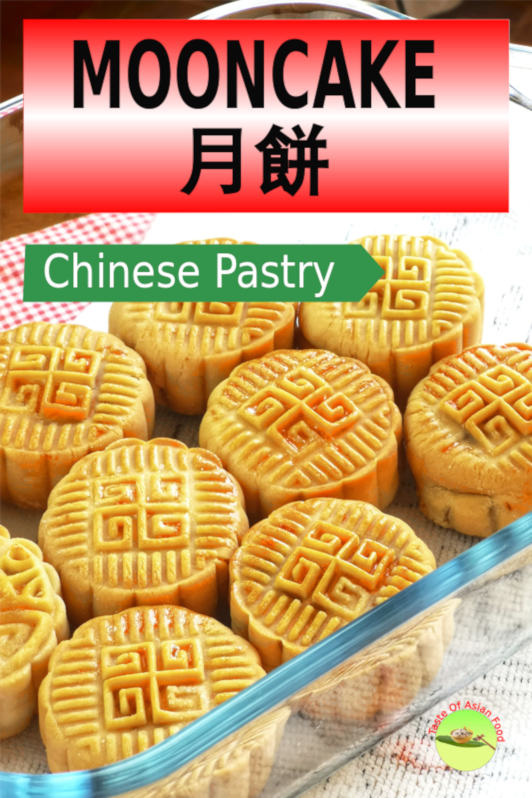
Mooncakes have become very fancy these days. You can find them filled with all kinds of ingredients, covered in elaborate designs, and packed in beautiful gift boxes.
But if you want to learn how to make a good traditional mooncake, I think it is best to start with the classic Cantonese-style mooncake.
Why? Because the basic method gives you the foundation for many other mooncake variations. Once you understand how to make the soft pastry, wrap the filling, shape it with the mold, and bake it properly, you can explore other styles with much more confidence.
This recipe keeps things simple by using ready-made lotus paste and salted egg yolks, so you can make traditional Cantonese mooncakes at home without having to prepare the filling from scratch.
Content
Note: Click any item to jump straight to that part of the post.
Note: This post may contain affiliate links. Please read my privacy policy for more info. I may receive commissions for purchases made through links in this post. As an Amazon Associate, I earn from qualifying purchases.
Why This Recipe Works
- Traditional flavor: Golden syrup pastry, lotus paste, and salted egg yolk are the classic Cantonese combination.
- Simple preparation: Using store-bought lotus paste saves a lot of time and makes the recipe more practical at home.
- Small batch: Ten mini mooncakes are a manageable amount to shape and bake at home.
- Easy to customize: Once you learn the basic pastry and wrapping technique, you can try different fillings without changing the core method.
A Note About Expensive Mooncakes
Mooncakes are commonly given as gifts during the Mid-Autumn Festival, and some come in beautifully designed boxes with premium presentation. The packaging and presentation can add considerably to the price, even though the basic ingredients are relatively simple.
A homemade mooncake does not need an expensive box to make it special. The time and effort you put into making it yourself are part of the gift.
Ingredients Breakdown
- Golden syrup: Gives the pastry its sweetness, softness, color, and moisture.
- Vegetable oil: Keeps the pastry tender. I prefer a neutral-flavored oil such as corn, peanut, canola, or palm oil.
- Lye water: Balances the acidity of the golden syrup and helps develop the darker color of the baked pastry.
- Cake flour: Provides enough structure for the pastry without making it unnecessarily tough.
- Lotus paste: A classic Cantonese mooncake filling and the easiest option when using ready-made paste.
- Salted egg yolk: Adds the familiar salty, rich center that balances the sweetness of the lotus paste.
- Egg wash: Brushed onto the partially baked mooncakes to give the surface its golden color.
The recipe uses only a small amount of lye water, so measure it accurately. A kitchen scale is also important for dividing the pastry and filling consistently.
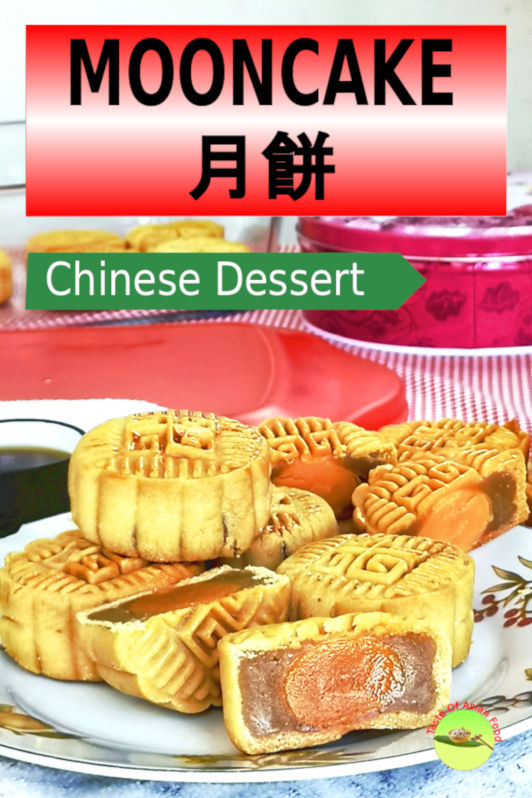
How to Prepare Everything Before Cooking
Prepare the dough
Measure the golden syrup, lye water, and vegetable oil accurately. Sift the cake flour and have it ready before mixing. Because the amount of flour needed can vary slightly depending on the golden syrup, I reserve a small portion of the flour to adjust the dough if necessary.
Prepare the salted egg yolks
If using fresh salted eggs, crack the eggs and separate the yolks from the whites. Wash the yolks gently to remove any egg white clinging to them, then pat them completely dry with a clean cloth or kitchen paper.
There is no need to pre-cook the yolks for this recipe. I tested both steaming and baking them beforehand and found that simply washing and drying the raw yolks gave the best result.
Prepare the lotus paste
Divide the lotus paste according to the weight of the salted egg yolks. The total weight of each filling portion should be 35g, including the yolk. If the yolk weighs more or less than usual, simply adjust the amount of lotus paste accordingly.
If the lotus paste is too soft to handle, refrigerate it briefly until it firms up.
Have the equipment ready
You will need a kitchen scale, mixing bowl, cling wrap or plastic sheets, a baking tray, a mooncake mold, and a pastry brush for the egg wash.
The complete ingredient quantities and measurements are provided in the recipe card below.
Step-by-Step Cooking Instructions
1. Make and rest the pastry dough
Mix the golden syrup, lye water, and vegetable oil in a mixing bowl until well combined.
Sift the cake flour and add about 95% of it to the mixture. Use a fork or stainless-steel whisk to bring everything together. It may look difficult to combine at first, but the liquid will gradually absorb into the flour.
Add the remaining flour gradually, only if needed, until a soft dough forms and there is no dry flour left in the bowl. Do not keep mixing once the dough has come together.
Wrap the dough with cling wrap and refrigerate for 30 minutes. This resting period allows the dough to relax, making it easier to roll and wrap around the filling.
2. Wrap the salted egg yolk with lotus paste
Take one salted egg yolk and wrap it with enough lotus paste to bring the total filling weight to 35g.
I prefer to flatten the lotus paste into a circle with the center slightly thinner than the edges. Place the yolk in the middle, then push the lotus paste upward around it until the yolk is completely enclosed.
Roll the filling between your palms to form a smooth ball. If the lotus paste is too soft to handle, refrigerate it briefly before continuing.
3. Wrap the filling with pastry
Take 18g of pastry and roll it out between two sheets of plastic or cling wrap. Flatten it into a circle roughly three times the diameter of the lotus paste ball.
Remove the top sheet and place the prepared filling in the center. Fold the pastry upward around the filling until it is completely enclosed.
Pinch away any excess pastry so that the layer remains as even as possible. Then gently roll the mooncake between your palms until it forms a smooth ball.
This is one of the most important parts of the process. The pastry should be thin and reasonably even, with no empty spaces between the pastry and filling. Otherwise, the two may separate during baking.
4. Shape the mooncake
Lightly dust the mooncake with flour and shake off the excess. Dust the piston of the mooncake mold in the same way.
Place the prepared dough on the baking tray. Position the mold over it and plunge the piston down. For a clear pattern, plunge the mold down lightly and repeatedly about seven to ten times. Keep the pressure reasonably even so the mooncake does not become lopsided.
Once shaped, move on to baking without leaving the molded mooncakes sitting around for too long.
5. Bake, apply the egg wash, and finish baking
Preheat the oven and bake the mooncakes on the middle rack at 175°C/350°F top and bottom temperature for five to six minutes, or until the surface begins to firm up.
Remove the tray and brush the mooncakes very lightly with egg wash. Be careful not to let egg wash collect inside the engraved pattern. If necessary, use a piece of kitchen paper to remove any excess egg wash.
Return the mooncakes to the oven and bake for another 10 minutes, or until they become golden brown.
If the pastry begins to crack during baking, give the surface one or two very light sprays of water from a distance before baking. Avoid spraying too much water onto any one area.
6. Cool and allow the mooncakes to rest
Remove the mooncakes from the oven and let them cool completely at room temperature.
Transfer them to an airtight container and keep them for three days before serving. During this time, the oil from the filling gradually moves into the pastry, making the outer layer softer and more moist. This process is commonly known as 回油 (hui you).
Freshly baked mooncakes can therefore feel firmer than you might expect. Give them time before judging the final texture.
A Few Tips From My Kitchen
Weigh the portions: A kitchen scale makes a big difference with this recipe. Dividing the pastry into 18g portions and the filling into 35g portions gives you a thin pastry layer without making the wrapping unnecessarily difficult.
Keep the pastry thin: I find that the mooncake is better when the pastry surrounds the filling rather than taking up too much of the bite. A thicker layer makes wrapping easier, but it changes the balance between the pastry and filling.
Use ready-made filling: Making lotus paste from scratch gives you more control over the sweetness, softness, and texture, but it is also time-consuming. For this recipe, I prefer using ready-made lotus paste because it makes homemade mooncakes much more practical.
Don’t pre-cook the yolk: I tested both steaming and baking the salted egg yolks before wrapping them, but neither gave me a better result. For these small mooncakes, I found that simply washing and drying the raw yolks worked best. The yolk cooks during the mooncake’s own baking process.
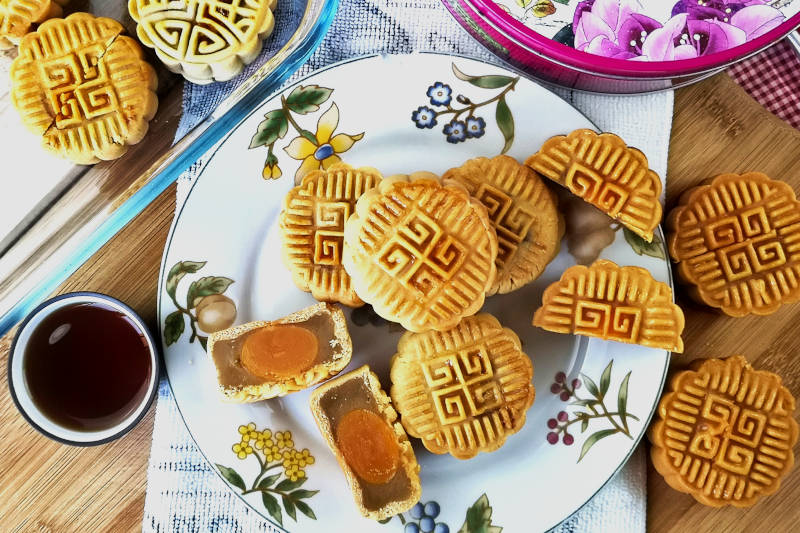
Common Mistakes to Avoid
Cracked pastry: Cracking can happen when the pastry or filling is not at the right consistency, or when the mooncake loses too much moisture during baking. If the pastry starts to crack, give it one or two very light sprays of water from a distance before baking.
Blurred pattern: Too much egg wash can collect in the engraved design and make the pattern less clear. Let the surface firm up during the first bake, then brush the egg wash very lightly and remove any excess from the pattern.
Filling separates from pastry: Gaps between the pastry and filling can cause them to separate during baking. When wrapping the mooncake, make sure the pastry fits closely around the filling, then roll it gently into a smooth ball.
Mooncake spreads: A filling that is too soft or a pastry that is too soft can cause the mooncake to lose its shape during baking. Make sure the filling and pastry are firm enough to handle before shaping.
Pale surface: Lye water helps develop the darker color associated with Cantonese mooncakes. If your mooncakes remain unusually pale, check that you have measured the lye water accurately.
White spots: Excess flour used during wrapping or molding can remain visible on the surface after baking. Use only enough flour to prevent sticking and shake off the excess before shaping.
Variations
Once you are comfortable with the basic pastry and wrapping technique, you can experiment with different fillings.
- Red bean mooncake: Replace the lotus paste with firm red bean paste for another traditional Cantonese-style filling.
- Black sesame filling: Black sesame paste gives the mooncake a stronger roasted, nutty flavor.
- Five-kernel mooncake (五仁月饼): This traditional style uses a mixed filling of nuts and seeds, often including melon seeds. It is a different filling rather than a simple variation of lotus paste.
- Pandan lotus: Pandan-flavored lotus paste is a nice variation, especially if you enjoy Southeast Asian flavors. It gives the traditional mooncake a distinctly Malaysian touch.
- Modern fillings: Contemporary mooncakes come in many flavors, including tea, chocolate, coffee, durian, and other creative combinations. They are interesting to try, but the traditional lotus paste and salted egg yolk combination is a good place to start if your goal is to learn the basic technique.
- Snow-skin mooncake: Snow-skin mooncakes are not simply another variation of this baked pastry. They use a completely different dough and do not require baking, so the method is quite different. I have a separate recipe for snow-skin mooncakes.
More Recipes to Try
Taiwanese Pineapple Cake – A crumbly pastry filled with sweet pineapple jam. It is another good recipe to try if you enjoy learning how to wrap a filling with pastry.
Salted Egg Pastry – A Chinese pastry made with salted egg yolk and a sweet filling. The flaky pastry is quite different from mooncake pastry, but the combination of salted egg yolk and sweet filling is familiar.
Snow Skin Mooncake – A soft, chewy, no-bake mooncake made with a different type of dough. If you enjoy traditional mooncakes, this is another style worth exploring.
Quick Takeaways
Traditional Cantonese mooncakes are more manageable to make than they look. Start with the classic version, get the pastry-to-filling ratio right, and let the finished mooncakes rest for three days to develop a softer texture.
Easy Mooncake Recipe
Traditional Chinese mooncake with lotus paste and salted egg yolk.
Ingredients
Dough
- 60g golden syrup
- 1/4 tsp lye water (kansui)
- 24g vegetable oil
- 100g cake flour
Filling
- 10 salted egg yolk
- 220g store-bought lotus paste (See note)
- Egg wash to brush the mooncake
Instructions
For the dough
- Mix the golden syrup, lye water, and vegetable oil accurately in a mixing bowl.
- Sift the cake flour. Add about 95% of the flour to the mixture and combine. Add the remaining flour gradually, only if necessary, until a soft dough forms.
- Place the dough on a piece of cling wrap and refrigerate for 30 minutes to let the dough relax.
For the filling
- Wash the salted egg yolks with water to remove any egg white sticking to them. Pat dry.
- Wrap each yolk with enough lotus paste to bring the total filling weight to 35g.
- Roll each portion into a ball and set aside.
Wrapping
- Take 18g of pastry and roll it out between two sheets of plastic or cling wrap.
- Remove the top sheet, place the filling in the center, and fold the pastry toward the filling.
- Pinch away any excess pastry to keep the pastry layer as even as possible.
- Roll the mooncake gently between your palms to form a smooth ball.
Shaping
- Lightly roll the mooncake in flour and shake off the excess.
- Dust the piston of the mooncake mold with flour and shake off the excess.
- Place the mooncake on the baking tray. Position the mold over the dough and plunge the piston downward.
- Plunge the mold down lightly and repeatedly for about seven to ten times to create a clear and even pattern.
Baking
- Bake on the middle rack at 175°C/350°F top and bottom temperature for five to six minutes, or until the surface starts to firm up.
- Remove the mooncakes from the oven and brush the surface lightly with egg wash.
- Use a kitchen paper towel to remove any excess egg wash trapped in the pattern.
- Return the mooncakes to the oven and bake for another 10 minutes, or until golden brown.
- Remove from the oven and cool at room temperature.
- Transfer the mooncakes to an airtight container and keep for three days before serving.
Notes
The amount of lotus paste is approximate because the weight of each salted egg yolk varies. The total weight of the filling, including the salted egg yolk and lotus paste, should be 35g per mooncake.
Recommended Products
As an Amazon Associate and member of other affiliate programs, I earn from qualifying purchases.
-
 Glad Cling N Seal Plastic Wrap for Food, Airtight Seal, 300 Square Foot Roll (Pack of 4)
 -
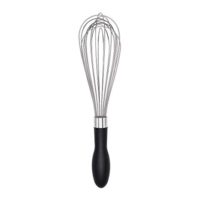
OXO Good Grips 11-Inch Better Balloon Whisk
-
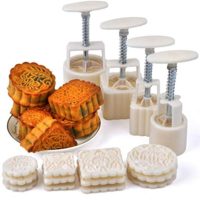
VOVOV Mid-Autumn Festival Hand-Pressure Moon Cake Mould With 12 Pcs Mode Pattern For 4 Sets
-
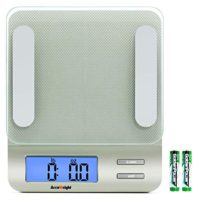
AccuWeight 207 Digital Kitchen Multifunction Food Scale for Cooking with Large Back-lit LCD Display,Easy to Clean with Precision Measuring,Tempered Glass, 0, Silver

Nutrition Information:
Yield: 10 Serving Size: 1 mooncakeAmount Per Serving:Calories: 140Total Fat: 5gSaturated Fat: 1gTrans Fat: 0gUnsaturated Fat: 4gCholesterol: 84mgSodium: 53mgCarbohydrates: 21gFiber: 1gSugar: 5gProtein: 3g
This data was provided and calculated by Nutritionix on 7/19/2019
Thank you for this recipe! I’m having an issue with inconsistencies with how the mooncakes turn out. I’m measuring things out exactly for 50g, but some of my mooncakes end up “melting” during baking (the shape changes and bulges out). The cake itself stays intact – just the shape gets deformed. And it’s not all of them in a batch, just a few. Any advice? What might I be doing wrong? Filling too oily?
Hi Liz,
It is hard to troubleshoot, but I would think the following might cause the problem:
– The pastry is too soft. Try to increase the flour of the dough by five to ten percent.
– Increase the baking temperature slightly to let the pastry cook faster so I can hold the filling quicker in the baking process.
I hope these methods are helpful.
Thanks.
KP Kwan
How long can we store the moon cake after baking?
Mooncakes filled with bean and lotus paste can be kept at room temperature for up to 2 weeks.
Keep the mooncake in a cool, dry place away from direct sunlight and heat.
It took me four hours 😛 not an hour as stated 😛
Thank you for all the tips shared. It made my first attempt a success!
Thank you so much for explaining ‘why’ you do things a certain way AND for showing your test results (the egg yolks). You’ve saved me several years of experimenting right there. 🙂
I love your style. Thank you for posting this!
Hi Courtney,
It is my pleasure to share 🙂
All the best.
KP Kwan
What if I wanted to make my own red bean paste . What are the quantities in grams ?
You need the same amount of red bean paste to replace the lotus paste. I never made it from scratch since ready-made red bean paste is also available where I live.